.webp)
Quality control in recycled plastic is not a line item on a spec sheet. It is the difference between resin that runs and resin that shuts you down. I have seen both sides. A clean lot of recycled polypropylene will run through an injection press all day without a problem. A dirty lot with cross-contamination and moisture will jam your screen pack in the first hour.
I deal with this every day at Poly Source. We buy scrap, process it, and sell resin to manufacturers who need material they can trust. QC is not something we bolt on at the end. It starts the moment feedstock hits our dock. This guide walks through the quality control measures that matter in recycled plastic production, from sorting through pelletizing, with real talk about where things go wrong and how to keep them right.
Key Takeaways
- Quality control in recycled plastic starts at the dock with incoming feedstock inspection, not at the pelletizer.
- Sorting failures are the most common root cause of off-spec recycled resin. Mixed resin types create processing problems downstream.
- Moisture, labels, adhesive residue, and cross-resin contamination are the biggest quality killers in recycled plastic production.
- Melt flow consistency is the single best indicator of whether a recycled lot will run well on production equipment.
- Post-industrial scrap is typically cleaner and easier to QC than post-consumer material, and that difference shows up in pricing and performance.
- Screen pack life, pellet uniformity, and lot-to-lot consistency are practical measures of whether your QC process is working.
Why Quality Control Matters in Recycled Plastic
Recycled plastic resin competes directly with virgin material on the production floor. If a lot of recycled HDPE or PP causes rejects, slows cycle times, or clogs screen packs, the plant manager is going to switch back to virgin and not look back. That is the reality we operate in.
QC exists to prevent that outcome. When the recycled resin runs clean, it earns its place. When it does not, the whole category gets a bad reputation. Every lot that leaves our facility reflects on every lot that comes after it.
Beyond production performance, quality control also matters for safety. Contaminants in recycled material can compromise the physical properties of finished parts. A pipe fitting that cracks, a container that fails under load, or a component that warps under heat can all trace back to feedstock that was not properly vetted. If you want to understand more about how material properties connect to end-use demands, our guide on choosing the right plastic for manufacturing covers the full framework.
Incoming Feedstock Inspection
QC starts before material enters the process. When a load of scrap arrives at our dock, it gets inspected before it goes anywhere else.
Here is what we are looking for:
- Resin identification: Is the material what it was described as? A load sold as polyethylene that turns out to be mixed PE and PP is a problem. Quick burn tests, density checks, or handheld infrared scanners help verify resin type on the spot.
- Contamination level: How much non-target material is in the load? Metal fragments, paper, wood, food residue, other resin types, and moisture all get assessed.
- Color and consistency: Is the material single-color or mixed? Natural (uncolored) feedstock is worth more because it can be compounded to any target color. Mixed-color loads get downgraded.
- Packaging and form: Is it baled, in gaylords, loose, regrind, or purge chunks? The form affects how it feeds into the process and how much prep work is needed.
Loads that fail incoming inspection get rejected or renegotiated. That sounds harsh, but it saves everyone time. Running bad feedstock through a clean process contaminates the process, not just the lot. If you are selling scrap through our buy and sell program, clear photos and honest descriptions up front avoid surprises on both sides.
Sorting and Separation
Sorting is where most QC battles are won or lost. The goal is simple: get each resin type isolated from everything else. The execution is where it gets complicated.
Effective sorting uses a combination of methods:
- Manual sorting: Trained operators pull obvious contaminants and misidentified materials off the line. This catches what machines miss.
- Optical sorting: Near-infrared (NIR) sensors identify polymer types by their spectral signature and blow non-target materials off the belt with air jets. This is fast and accurate for high-volume streams.
- Density separation: Float-sink tanks separate materials by specific gravity. HDPE floats in water while polystyrene and PVC sink. Simple physics, but effective.
- Magnetic and eddy current separation: Removes ferrous and non-ferrous metals. A piece of steel wire in a pellet lot will score a barrel or damage a screw tip.
The quality of sorting directly determines the quality of everything that follows. When sorting is sloppy, you get mixed resin in the extruder, and that shows up as gels, specks, or outright processing failures. A load of LLDPE contaminated with even a small percentage of nylon will behave differently in the melt than a clean lot, and the finished pellet will reflect it.
Cleaning and Shredding
Once sorted, the material needs to be cleaned and reduced to a consistent particle size. Both steps are critical for what comes next.
Cleaning removes surface contaminants: dirt, labels, adhesive residue, food residue, oils, and anything else that does not belong. Methods vary depending on the feedstock. Some material needs hot washing with caustic solution. Some only needs a cold rinse. Post-consumer bottles are typically dirtier than post-industrial trim from a BOPP film converter.
Shredding reduces the cleaned material to flake or chip form. Uniform particle size matters because it affects how evenly the material feeds into the extruder. Oversized pieces cause bridging in the hopper. Fines create dust and inconsistent melt behavior.
Moisture control is non-negotiable during this stage. Wet flake going into an extruder causes steam pockets, foaming, and surface defects in the pellet. Drying systems need to bring moisture content down to the level the resin requires. Different resins have different tolerances. Nylon 66, for example, is far more sensitive to moisture than LDPE.
Testing for Contaminants
Testing is the verification layer. It confirms whether the sorting and cleaning steps actually did their job.
Practical testing methods used in recycled plastic production include:
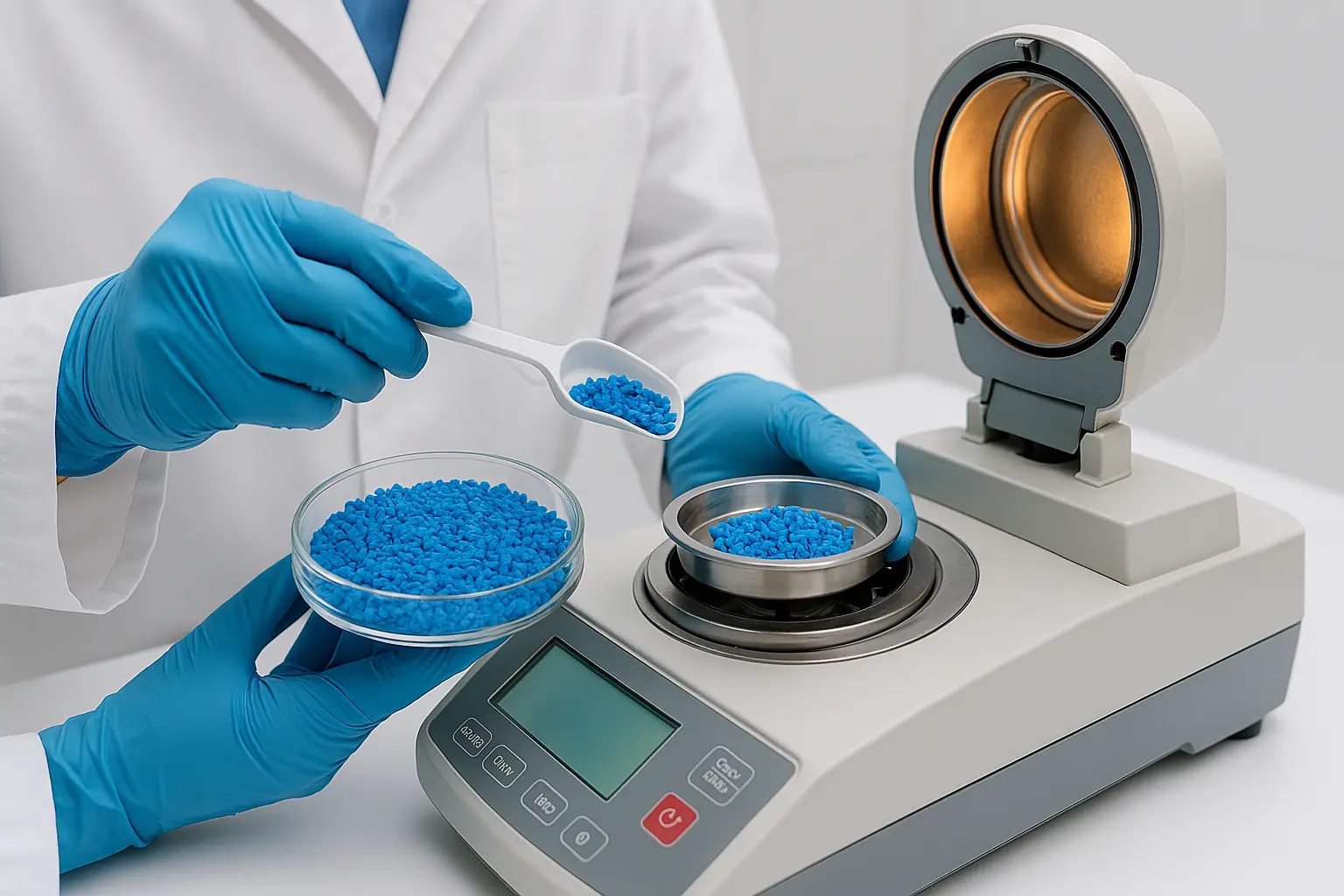
- Melt flow index (MFI) testing: Measures how the material flows under heat and pressure. This is the single most useful test for predicting how recycled resin will behave on production equipment. If the MFI drifts between lots, the processor will see it in cycle time and part quality.
- Density measurement: Confirms resin type and grade. A density that does not match the spec usually means there is another resin mixed in.
- Moisture analysis: Confirms the material is dry enough to process without defects. Especially important for hygroscopic resins like nylons.
- Visual inspection of pellets: Gels, black specks, discoloration, and irregular pellet shape all indicate process issues or feedstock contamination.
- Ash content testing: Detects inorganic fillers and additives. A recycled PP lot with unexpectedly high ash content may contain talc-filled material that was not separated during sorting.
Some operations also use differential scanning calorimetry (DSC) to identify mixed polymers. DSC can detect a secondary melt peak that indicates cross-contamination, even at low levels. This is especially useful when working with polyethylene streams where HDPE and LDPE might be mixed.
Melting and Filtering
The extrusion step transforms clean flake into molten plastic, and the filtration step catches whatever the upstream processes missed.
Temperature control during melting is critical. Too hot and the polymer degrades, losing mechanical properties. Too cool and you get unmelt, which shows up as specks or gels in the pellet. Each resin has an ideal processing window. We covered HDPE's melting point and processing behavior in a separate post.
Filtration uses screen packs or continuous screen changers to remove particulates from the melt stream. The screen mesh size is a balancing act. Too fine and the screen clogs fast, reducing throughput. Too coarse and contaminants pass through into the pellet. Screen pack life is actually a useful QC metric. If screens are clogging faster than expected, the feedstock is dirtier than it should be.
Continuous screen changers help maintain pressure stability during production, which matters for pellet consistency. Pressure spikes from a clogged screen show up as pellet weight variation and surface defects.
Pelletizing and Blending
Pelletizing converts the filtered melt into the final product: uniform pellets ready for production. Strand pelletizing and underwater pelletizing are the two main methods. Both produce good results when the melt stream is clean and consistent.
What I watch for at this stage:
- Pellet size uniformity. Undersized pellets and fines cause feeding issues. Oversized pellets melt unevenly.
- Pellet shape. Tails, strings, and irregular cuts indicate die or cutter problems.
- Color consistency across the lot. Color drift means the input stream shifted during the run.
- Bulk density. It should be consistent across bags or boxes within a lot.
Blending happens when the application requires it. Recycled pellets may be blended with virgin resin, colorants, UV stabilizers, or other additives to hit a target spec. Effective blending requires that the base recycled pellet is itself consistent. If the recycled component varies lot to lot, no amount of blending fixes that.
Our polypropylene recycling guide walks through the full scrap-to-pellet process in more detail, including how blending and compounding fit into the picture.
QC Checkpoints Across the Process
Here is a summary of where quality control checks should happen and what each checkpoint catches.
| Process Stage | QC Checkpoint | What It Catches |
|---|---|---|
| Incoming feedstock | Visual inspection, resin ID, moisture check | Wrong resin, excessive contamination, wet loads |
| Sorting | Spot checks on sorted output, NIR verification | Mixed resins, metals, non-plastic contaminants |
| Cleaning | Surface inspection, wash water quality | Residual labels, adhesives, food residue, oils |
| Shredding | Particle size distribution, moisture measurement | Oversized or undersized flake, excess moisture |
| Extrusion | Melt temperature, pressure monitoring, screen life | Degradation, unmelt, excessive contaminants |
| Filtration | Screen pack change frequency, pressure differential | Particulate contamination beyond spec |
| Pelletizing | Pellet size, shape, color, bulk density | Irregular pellets, color drift, inconsistent density |
| Final QC | MFI, density, ash content, visual | Off-spec melt flow, resin contamination, filler issues |
Each of these checkpoints generates data. The more consistently you collect and review that data, the faster you catch problems before they become lot rejections.
Common QC Failures and What Causes Them
Most quality failures in recycled plastic trace back to a few root causes. Here are the ones I see most often.
Gels and specks in pellets: Usually caused by cross-resin contamination or degraded polymer. A small amount of a higher-melt-point resin mixed into a lower-melt-point stream will not fully melt and shows up as gels. The fix is better sorting upstream.
MFI drift between lots: Happens when the feedstock stream changes and nobody catches it. One truckload of regrind might be from injection molding scrap (lower MFI) and the next from blow molding scrap (higher MFI). If both get processed together without adjustment, the output MFI wanders. Incoming inspection should flag this.
Moisture-related defects: Bubbles, surface roughness, and foaming during extrusion. The material was not dried adequately before processing. This is especially common with nylons and ABS, which absorb atmospheric moisture quickly after drying.
Color inconsistency: Mixed-color feedstock that was not properly segregated. Or a color concentrate that was not metered correctly during blending. Either way, the customer sees it immediately.
Odor: Post-consumer material that was not washed thoroughly can carry odors into the pellet. This is a dealbreaker for many packaging and consumer goods applications.
Post-Industrial vs Post-Consumer: QC Differences
Not all scrap is created equal, and the QC requirements differ significantly between post-industrial and post-consumer feedstock.
Post-industrial scrap comes from manufacturing operations. It includes regrind, off-spec parts, trim, purge, and edge scrap. This material is usually single-resin, single-color, and has a known processing history. QC is simpler because you know what the material is and where it came from. The main risks are mixed grades (different MFI resins from the same plant) and metal contamination from processing equipment.
Post-consumer scrap comes from curbside programs and collection systems. It has been used, exposed to unknown conditions, and mixed with other materials. QC is harder. You are dealing with label contamination, food residue, unknown additives, UV degradation, and resin blends. The sorting and cleaning burden is significantly higher, and the resulting pellet usually has more variability than post-industrial output.
This difference is why post-industrial recycled resin typically commands a higher price and is preferred for applications where consistency matters most. At Poly Source, we work with both streams, but we are honest with buyers about what each one can deliver. If you need tight specs, post-industrial feedstock is the better starting point. Our case studies show real examples of how different feedstock types perform.
How to Implement QC in Your Operation
Whether you are running a recycling line or buying recycled resin for your production floor, here is how to build quality control into your process.
For recyclers and processors:
- Define written procedures for every step from incoming inspection through final pellet QC.
- Train operators on what to look for. A trained eye catches problems that instruments miss.
- Invest in basic testing equipment: MFI tester, moisture analyzer, density measurement setup, and a good magnifying glass for pellet inspection.
- Track screen pack life as a process health metric. If it is getting shorter, your feedstock quality is slipping.
- Keep lot records. When a customer has a problem, you need to trace it back to a specific run and specific feedstock.
For buyers running recycled resin:
- Request MFI data and COA (certificate of analysis) with every lot.
- Run a trial before committing to volume. Test the material on your actual equipment with your actual process settings.
- Establish incoming inspection at your dock. Check moisture, visual appearance, and MFI on arrival.
- Work with a supplier who can provide consistent lots over time, not just a one-off deal.
If you are looking for a supplier that takes QC seriously, browse our available recycled resin or contact us to talk about what you need. We work with PP, HDPE, LDPE, polycarbonate, and other commodity resins across the U.S. Check our areas serviced for coverage.
Talk to Us About Your Material
If you are sitting on a stream of scrap and you want to know if it is worth moving, send me what you have. Pictures help. So do rough weights, how it is packed, and what it touched. I will tell you straight if it fits, what I would need cleaned up, and the easiest way to get it on a truck. And if you are buying recycled resin and want material that actually holds spec, reach out here or browse what we buy and sell.
Frequently Asked Questions
What is the most important QC test for recycled plastic?
Melt flow index (MFI) testing is the single most useful test for predicting how recycled resin will perform on production equipment. If the MFI is within spec and consistent lot to lot, the material will generally run well. MFI drift between lots is one of the top causes of processing problems with recycled resin.
Why does recycled plastic sometimes have gels or specks?
Gels and specks typically come from cross-resin contamination or degraded polymer. When a small amount of a different resin type is mixed into the feedstock, it may not fully melt at the processing temperature and shows up as visible defects in the pellet. Better sorting and filtration upstream are the primary fixes.
How is post-industrial recycled plastic different from post-consumer?
Post-industrial scrap comes from manufacturing and is usually single-resin, single-color, and has a known processing history. Post-consumer scrap comes from curbside collection and carries more contamination, mixed colors, label residue, and variability. Post-industrial material is easier to QC and typically produces more consistent recycled resin.
What contaminants cause the most problems in recycled plastic production?
The biggest quality killers are mixed resin types, moisture, label and adhesive residue, metal fragments, and food contamination. Even small percentages of a wrong resin type can cause processing failures. Moisture causes foaming and surface defects during extrusion.
How do I know if my recycled resin supplier has good quality control?
Ask for MFI data and a certificate of analysis (COA) with each lot. Request lot traceability information. Run a trial on your production equipment before committing to volume. A good supplier will provide consistent data, welcome questions about their process, and stand behind their material if problems arise.
Can recycled plastic match virgin resin quality?
In many applications, yes. When the feedstock is clean, properly sorted, and processed with consistent controls, recycled resin can perform close to virgin specs. The key is feedstock quality and process discipline. Applications that demand the tightest specs often start with post-industrial feedstock because it offers better consistency.
What does screen pack life indicate about recycled resin quality?
Screen pack life is a practical indicator of contamination level in the melt stream. If screens are clogging faster than expected, the feedstock contains more particulates, gels, or unmelt than it should. Tracking screen change frequency over time helps identify when feedstock quality is slipping before it affects the final pellet.